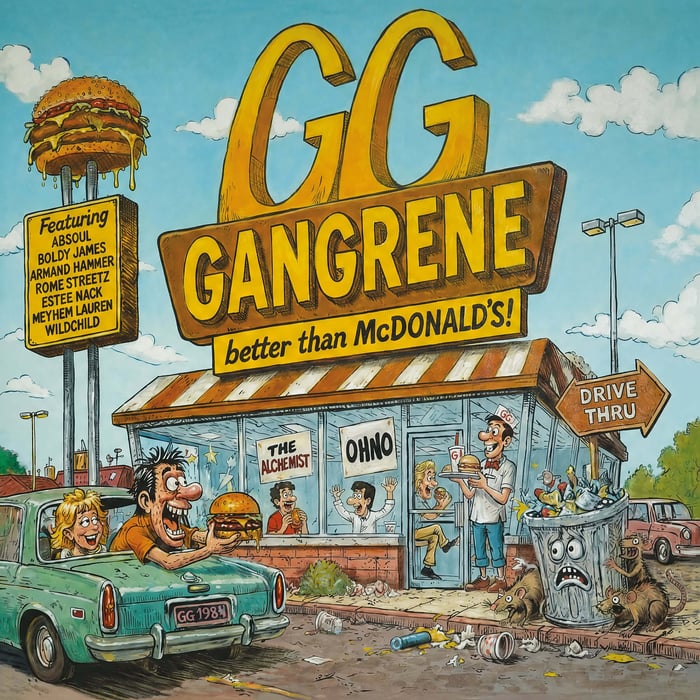
sum breakup songs Review: Dru Kelly & Stix Turn Heartbreak Into Homework


 See more Architeg Prints stories on Google.
sum breakup songs Review: Dru Kelly & Stix Turn Heartbreak Into Homework
sum breakup songs turns a “best friend check-in” into a whole breakup spiral—funny, ugly, tender, and occasionally self-sabotaging on purpose.

This album opens like a phone call you shouldn’t answer
You know that moment when your friend calls “just to check in,” and ten seconds later you’re trapped in a two-hour emotional hostage situation? sum breakup songs basically builds its whole identity out of that.
Stix keeps dialing in—literally—and Dru Kelly keeps pretending he’s fine in the specific way only a not-fine person can. The twist is that the “skit” setup that rap usually treats like a disposable joke is the spine of the project. The calls aren’t decoration. They’re the pressure gauge, the narration, and sometimes the enabling.
And yeah, it’s their third project this year, which sounds like it should mean “rushed.” Strangely, it doesn’t feel rushed. It feels cornered.
The phone-call gimmick isn’t a gimmick here—it’s an alibi
Most rap phone calls are fake intimacy—an intermission you forget as soon as the drums come back. Here, Stix calling in as the best friend/producer lands like a way to make the mess sound organized. Like: if we frame this as “checking on the homie,” then whatever Dru admits next is just part of the process.
That framing matters because Dru spends the record doing something pretty bold: he doesn’t just narrate heartbreak, he audits it. He’s not only sad—he’s investigating his own sadness, testing it, making charts out of it, and then immediately failing the test anyway.
If you’ve ever heard an album where the structure is trying to keep the artist from spiraling, this is that album.
“take my lungs” is where the heartbreak stops being poetic and gets weirdly practical
The first time “take my lungs” played, I expected the usual: barstool self-pity, romantic fog, maybe a slow hook you can half-sing. But Kelly starts in Jeff County energy—sleepy in a bar, asking the bartender where his girl went—and then he slips in a line that’s not even dramatic, just bleakly statistical: he’s twenty-five, and he’s already calculating how long it’ll take to “get over” heartbreak.
That’s the album’s real trick. It’s not sad music. It’s “I ran the numbers on my devastation” music.
Stix builds one of his most crowded constructions here: soulful sample framework, big emotional ceiling, and Dom Mooney showing up as the featured voice in the room. Dru’s drinking isn’t framed like a party problem. It’s framed like a tool that isn’t even doing the job anymore—“drowning out the pain,” but not beating it.
And the title idea—wanting someone to “take my lungs” instead of “take my breath away”—isn’t a clever twist. It’s a confession that romance isn’t romantic anymore. He’s asking for surgery, not butterflies.
That’s not subtle. That’s the point.
“bridge” and “shorty” show the album’s ugliest honesty: the mood swings are the narrative
“bridge” drops Kelly into a broken-down Altima, wondering why he even had a wife at twenty-five. It’s the kind of line that sounds like a throwaway until you realize the album keeps returning to that age like it’s a crime scene marker.
Then “shorty” flips the emotional polarity mid-verse—alimony talk, bipolar thoughts switching up weekly—until he tosses out one of the most desperate “romantic” offers left in his arsenal: he doesn’t believe in God, but he tells her she’s a god to him.
It’s sweet for half a second, and then it’s also kind of terrifying—because it’s clearly the last coin in his pocket. He’s cashing it in to keep the door cracked open.
What’s wild is how he crams contradictions into the same hook: promising to dive off a cliff for her while swearing no woman will ever take his pride again. That’s not character development. That’s active emotional whiplash, recorded in real time.
A lot of artists fake complexity. This is just messy.
“i’m doing alright, it’s about time” nearly convinces you… which is exactly why it works
This is where Kelly gets beneath his own addiction instead of decorating it. He says he’s scared of sobriety, and it doesn’t come out like an inspirational line—it comes out like a shrug you hate yourself for recognizing.
There are small, specific tells that make it feel lived-in: keeping it together at work with a Tito’s and lime; getting muscle relaxers by complaining about a hurting back. That’s not movie-addiction. That’s boring, functional, day-to-day self-medication.
Stix makes a smart choice here: he holds back the drums, leaves soft chords and a tighter vocal space, then lets the track open up as the idea of “alright” starts to sound… not true, exactly, but possible. Like the song itself is testing whether it’s allowed to stabilize.
I’m not totally sure if the optimism is real or just a temporary chemical window, and honestly, the not-knowing is what makes the track land.
“drank kicked in” is the point where the writing starts punching walls
Nothing about “drank kicked in” is composed. The whole song is waiting-room music for numbness: “waiting for the drank to kick in,” “waiting for the pain to get lost.” It’s relief as a scheduled event.
But when the anger takes over, Kelly’s pen starts to stumble. He turns on an ex for calling him insecure, wishes she burns, then wishes she learns—like he’s flipping between revenge and self-respect and landing on neither.
And yeah, this is where the album shows a seam: a Billy/William line that doesn’t actually go anywhere, and an Erica Kirk name drop that feels like it should’ve stayed in the booth. The harsh part is that you can hear him reaching for a sharper dagger and grabbing whatever’s closest.
Still, he nails one short bar that says more than the clutter around it: “Lost years of my youth in a pigpen.” That’s the kind of line that doesn’t need explanation. You either flinch because you get it, or you don’t.
“omg wtf” admits the whole thing sounds like a cry for help—then keeps going anyway
On “omg wtf,” Kelly starts calling her every name he can pull off the shelf, and he can’t even keep the lyrics clean all the way to the end. He cuts himself off at “I mean, I’m just trying, bitch,” and the most revealing part is that it’s the only insult he throws that feels aimed at himself.
The track has this chaotic mix—coke jokes, chiropractor sex talk—and then a sudden moment of self-awareness: he admits the way they’re moving feels like a cry for help, and he can’t help because he’s crying too.
Kiran The Nomad matches that agitation with a speech-style verse and a chess-logic metaphor—sacrificing your queen as a move. It’s the kind of feature that doesn’t “save” the song so much as underline what the song is: a mind arguing with itself at full volume.
Here’s the uncomfortable part: the album starts letting contempt for one woman spill into contempt for women generally. Each time that spill happens, the songs don’t get more intense—they get smaller. Meaner. Less precise. And that’s not “edgy.” That’s just losing the plot.
“nosey” and “MINNEAPOLIS” feel like the album testing how much you’ll tolerate
“nosey” ends with a spoken rant about hating contentious women. It’s pitched like a joke—one of those jokes where the joke is that he’s serious. The problem is that it’s tacked onto a song that, up to that point, was reaching for something more human: wanting his mama, staring at a face he won’t blame for the trauma.
So the rant doesn’t feel like “comic relief.” It feels like sabotage. Like he had a chance to stay vulnerable and decided to swerve into bitterness instead, just to prove he could.
Then “MINNEAPOLIS” barely counts as a song at all. It’s more like a rough sketch over an 808-style floor: Stockholm jokes, a vasectomy line, Winston Churchill and Urkel puns, and a hook built out of “pussy, money, ass, and titties.” It plays like he’s trying to outrun sincerity by acting like a clown in the middle of his own breakup album.
I kept waiting for it to turn into something heavier, but it mostly just shrugs and leaves.
Stix keeps talking because he’s not just producing—he’s steering
Stix doesn’t just make the beats. He plays best friend in the narrative, and it’s not subtle. On “i’ll have yk paint you,” he introduces himself like he’s filing paperwork after the news breaks. It’s half check-in, half brand management.
Then he comes back to explain—at length—that when Kelly threatens “I pay YK my name to go paint your bitch,” it’s not about people misunderstanding Stix’s hobby. The explanation is so specific it becomes funny, but also: it’s clearly important to them that the audience “gets it.”
Meanwhile, Kelly has already moved past negotiation: “I already stamped / Don’t need a stamp of approval from you.” He decides love is a scam, and he scratches his ex out of pictures with a purple crayon—such a strange detail it feels undeniably real. Nobody invents “purple crayon” unless they’ve actually done something that petty and then stared at it afterward like, what am I doing?
“i’m grown” is a pep talk that accidentally reveals the real damage
The “i’m grown” monologue goes all in: Stix basically declares Kelly one of the coldest rappers and tells him to stop mentioning divorce. It’s supportive, sure—but it also feels like a friend trying to duct-tape someone’s self-image back together.
Kelly’s response is the meanest hook and the clearest self-summary on the record: “An alcoholic who happens to lack the shit to solve it.”
That line doesn’t want your sympathy. It wants your agreement. It’s him putting a label on himself before anyone else can.
This is where my first impression changed a bit: I thought Stix’s “friend voice” would feel corny after a couple tracks, like an overused skit. But it starts to feel like a brace. Sometimes it holds Kelly upright. Sometimes it just keeps him from falling where he might actually learn something.
“peachy” uses guest looseness to make Kelly’s darkness hit harder
On “peachy,” Ykmyname opens with “I am not McLovin,” then drifts through selling weed to his older cousin and dropping out of school. It’s the loosest guest verse on the project—almost casually tossed off.
But that looseness is a contrast weapon. Because when Kelly comes in, he’s digging up uglier memories: watching addicts shoot up until their veins wore out, hearing about a dog who took two Perc 30s and ended up brain dead—“but cool now,” “lucky,” the kind of grim optimism people use when the alternative is admitting how bad it really is.
The track doesn’t ask you to feel inspired. It asks you to sit there while he normalizes the unnormalizable.
“thousand years” and “will i ever be loved” are where the album stops posturing
Dom Mooney delivers the heaviest guest performance on “thousand years”—scarred skin, wire, sleeping in the snow, ounces on the scale like a physical burden. It’s not flashy; it’s weight-bearing.
And then Kelly drops the quiet part of divorce without dramatizing it: “You might’ve loved me / I just think I might’ve loved you more.” That’s not a bar designed to win. That’s a line designed to hurt the person saying it.
On “will i ever be loved,” Stix strips the production down: deep bass, sparse drums, dark loop. Kelly asks the title question like he’s asking it into an empty room, then admits the one regret that won’t leave him alone—the marriage. “You were my love for ten years / How the fuck we even get here?”
He compares it to an avalanche coming off a broken man and wonders if she can love what’s left—the leftovers. It’s blunt, unpretty, and it’s the moment the album’s “talk” becomes something closer to truth.
“a giver” is the detachment track—the one that scares me a little
By “a giver,” Kelly sounds resigned in a way that’s almost calmer than happiness. Rounded bass, steady kick and snare—no theatrics. Letting go feels like taking Lexapro. The guy who used to pay a mortgage is renting again. The scale of loss is domestic, not cinematic.
He leans into clichés—“you don’t know what you got ‘til it’s gone,” sleeping alone feels weird, wishing to go back home, focusing on the kids—but the hook redeems the familiarity by turning the pun into an actual question: “Know you a giver / Then what gives?”
And then he answers it like he surprised himself: “Thought without you I couldn’t live / Oh, look at me live.”
That’s the album in one motion: writing his own ending, then watching himself outlive it.
Where it lands: great, not flawless, and definitely not polite
This is one of those projects that earns its mess because it’s showing you the mess, not polishing it into content. When it’s tender, it’s sharply observed. When it’s bitter, it can get sloppy—and that sloppiness is the one thing that actually drags the record down, because it dilutes the specificity that makes Kelly hit so hard everywhere else.
Still, when Stix lays out a soulful frame and Kelly stops trying to win the breakup, the songs feel like they’re doing something rarer than “relatable”: they’re documenting the exact ways a person keeps living while they’re still mentally arguing with someone who isn’t in the room.
Favorite tracks that actually prove the point:
- “take my lungs”
- “peachy”
- “a giver”
Conclusion
sum breakup songs isn’t a tidy heartbreak story—it’s a running log of coping strategies colliding in public, with Stix acting like both producer and friend-shaped guardrail while Dru Kelly alternates between clarity and combustion.
Our verdict: If you like breakup music that keeps the bruises visible—and you don’t need the narrator to be likable every second—you’ll actually like sum breakup songs. If you want clean moral lessons, tidy empowerment, or “growth” that arrives on schedule, this album will irritate you the way a truthful voicemail irritates you.
FAQ
- Is sum breakup songs more about rapping or storytelling?
It’s rapping as storytelling—bars first, but the emotional plot keeps leaking through, especially on “take my lungs” and “a giver.” - Do Stix’s phone-call moments feel like skits?
At first they seem like skits, but they turn into the album’s frame—sometimes helpful, sometimes oddly controlling. - What’s the most emotionally direct track?
“will i ever be loved” is the bluntest moment: minimal beat, maximal regret, no cute exits. - Does the album ever go off the rails?
Yes—when anger turns into broad contempt, like parts of “nosey,” it starts feeling less sharp and more like collateral damage. - Where should I start if I only play three songs?
“take my lungs,” “peachy,” and “a giver” give you the full range: barstool grief, memory trauma, and post-breakup survival math.
If you want to keep the album’s mood on your wall (instead of in your group chat), you can shop a favorite album-cover poster at our store: https://www.architeg-prints.com. It fits this record’s vibe—bold, a little absurd, and hard to ignore once you’ve seen it.
 | DISCOUNTGET 30% OFF*Use code on your next order:
|
* This post may contain affiliate links, meaning we earn a commission if you make a purchase through these links, at no additional cost to you.