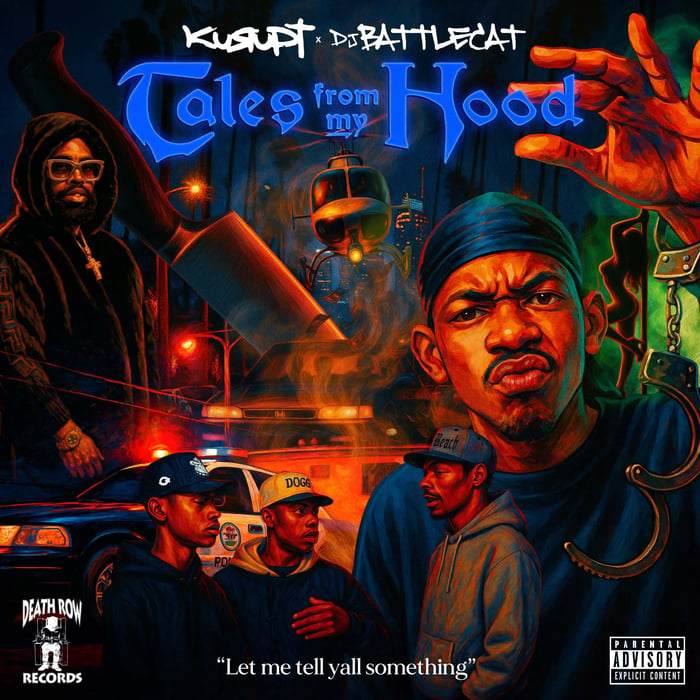
Tales from My Hood Review: Kurupt & Battlecat Turn Roll Call Into Cinema


 See more Architeg Prints stories on Google.
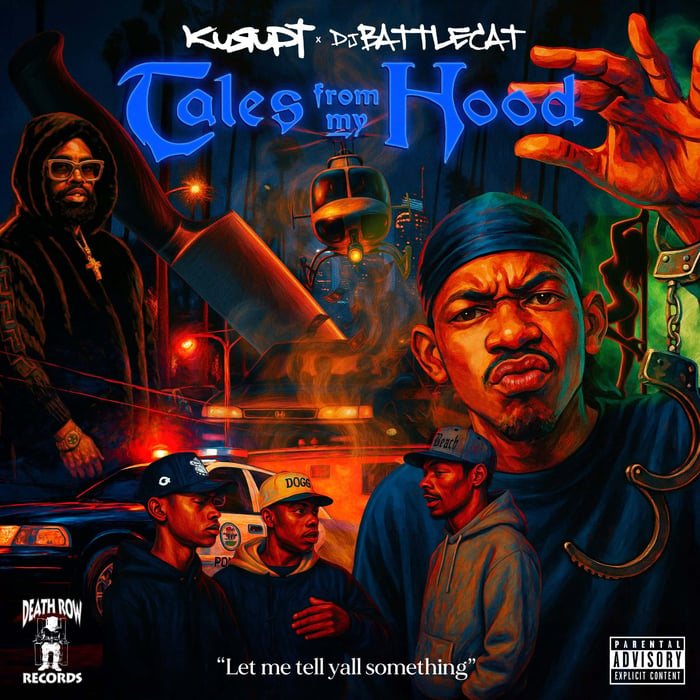
Album Review: Tales from My Hood by Kurupt & DJ Battlecat
An opinionated Tales from My Hood review: Kurupt name-drops like it’s cardio, and DJ Battlecat makes the room feel way too alive to ignore.
This album isn’t storytelling. It’s attendance-taking.
Some albums try to “paint a picture.” Tales from My Hood doesn’t paint anything—it scans the room, reads the license plates outside, and tells you who’s missing.
Kurupt’s whole thing here is people. Not “the streets” in the abstract. Actual bodies, actual names, who was in the car, who wasn’t home, who’s on the corner, who’s got the blower, who’s about to make everything worse. And DJ Battlecat—stealing the show with classic West Coast and G-funk moves—sets it up like he’s building a stage just so Kurupt can pace around on it and point at faces.
Kurupt (Ricardo Brown) moved from Philadelphia to Hawthorne at 16, then landed in Los Angeles at 18. Listening to this, that timeline matters. The writing doesn’t sound like somebody romanticizing a neighborhood from a distance. It sounds like somebody who learned, fast, that your survival depends on details: who’s present, who’s watching, and who’s about to flip.
Battlecat’s real flex: he makes the “roll call” feel like a movie
Here’s my arguable take: Battlecat doesn’t just “produce” this thing—he keeps Kurupt from floating off into pure talk.
The beats have that classic West Coast ease, but they aren’t lazy. They’re structured like scenes. The music keeps giving Kurupt doorways to walk through: one moment you’re cruising, next moment you’re cornered, then suddenly you’re back outside acting normal like nothing happened.
At first, I thought the album was going to be a simple victory lap—slick grooves, familiar names, the usual. On second listen, it felt more like a controlled habit: Kurupt keeps returning to the same mental rooms and counting who’s inside because that’s how he stays oriented. Like a man checking his pockets every five minutes, not because he’s paranoid, but because he’s learned what happens when you don’t.
“Sneak Attacc” is where the album shows its teeth
This is the track where the plot actually moves.
The “job” on “Sneak Attacc” is robbery logic laid out like a crooked spreadsheet. Kurupt runs through what they aren’t hitting—banks, liquor stores, houses—then immediately yanks the rug:
“We ain’t hittin’ banks, we ain’t hittin’ liquor stores / We ain’t even doin’ jack moves no more… We hittin’ all of the above.” — Kurupt
That’s the album in miniature: a straight face while doing something blatantly self-contradictory. He says “we’ve evolved,” then admits the evolution is just getting greedier.
Snoop shows up counting shots, mapping the route from Crenshaw to Slauson, then basically turns his verse into that specific kind of chaos where the night stops being “a plan” and starts being “damage control.” Parties get hit. Homies appear posted up. Somebody gets shot. The chase starts. And the paranoia spreads outward—now the cops aren’t just looking for Snoop, they’re looking for whoever’s associated with him. That’s a real street detail, and it lands harder than the gun talk.
Then the camera jumps inside the car for the second verse: “Heater in my left, steering wheel in my right hand.” That line isn’t poetic; it’s practical. And he’s thinking about Texas, not because he’s daydreaming, but because escape has to be logistical—stack money, set up a caravan out of town, split up, meet back at the spot if everyone makes it. That “if” does a lot of work.
Arguable claim: this is the album’s best “action scene,” and it makes a few later tracks feel like they’re hanging out in the lobby instead of advancing the story.
“Me N the Boyz” acts busy, but nothing actually happens
Now the album pivots from motion to routine.
On “Me N the Boyz,” the goal is simple: get the bag. But the song spends its whole runtime circling the act of getting money straight—late nights, upgraded status, calling shots from Long Beach to Watts—without anchoring any of it to a particular night or consequence. It’s like watching someone organize receipts.
The one line that actually introduces people in a sharp way is: “They don’t sell they bodies, they just crack the stores.” That’s blunt, almost tossed off, and it’s the most “located” moment in the whole track.
Then you get this thinning-out of the “West Coast Muzik” vibe—still smooth, but less lived-in than “Sneak Attacc.” Butch Cassidy spends his verse summoning girls. Kurupt closes by describing a woman from her feet up to her waist. And then… that’s it. The song ends before anyone in it has done anything, good or bad.
Mild criticism, because it’s earned: this one feels like a placeholder for a feeling rather than a scene. The groove is there, but the track doesn’t cash its own check.
“Wat U Do to Me” finally fills the room with actual bodies
This is where the album breathes again.
D Smoke joins “Wat U Do to Me,” and suddenly the room has people in it: women, two-stepping, a party that refuses to end. There’s even an explicit nod to Battlecat laying the foundation—because honestly, you can hear it. The beat feels like a floor that can hold weight.
Snoop takes the last verse and gives advice that’s half practical, half nonsense in the way advice often is when it comes from somebody who survived a lot. “Keep a good lawyer, Tom Sawyer.” It’s ridiculous on paper, but in the track it plays like a proverb you don’t fully get until you need it.
Arguable statement: the “party” framing here isn’t celebration—it’s camouflage. Everybody’s moving, so nobody has to explain what they’re thinking.
“Mindstate” has the best guest moment, and it changes Kurupt’s posture
Ill Camille opens “Mindstate” with the strongest guest feature on the album, and she does it by being specific: she remembers meeting him, remembers what he called her afterward—sister, and also one of his killers. That’s affection and menace in the same breath, which is basically the emotional language of this record.
Kurupt answers with a verse that loops like a war calendar: going to war, returning, going back again; touring, returning, leaving again. And then he drops the real reason the pattern matters—staying away is part of why he’s still alive. That’s not a brag. It’s a survival strategy stated plainly.
I’ll admit I’m not completely sure whether the track wants to be inspirational or just honest. But I do know it’s one of the few moments here where the “hood tales” turn into a psychology tell.
Arguable claim: “Mindstate” is the album’s emotional thesis even though it doesn’t announce itself as one.
“Love Letter” tries to rebuild a heart like it’s a toy set
“Love Letter” is heartbreak, repair, and that specific stubborn optimism of trying again. Kurupt puts the heart back together like Lego blocks—piece by piece, pretending the cracks are just seams.
There are long walks. Trips to the Caribbean. A house that got turned into a home. Jane Handcock carries the song with a hook that feels like it’s looking over a timeline of lovers coming and going, and she sounds like the only one in the room willing to say time out loud.
Kurupt’s most sticking detail is the Nevada line—he knew once they hit the state they were going to marry. That’s the kind of specificity he’s good at: not “I knew she was the one,” but “geography made it real.”
Arguable statement: this track works because the singing doesn’t beg for sympathy—it just holds the mood steady while Kurupt narrates the wreckage.
“Special” starts vivid, then loses the person it’s supposed to be about
“Special” comes in with more life. Kurupt opens with a funny, mean detail—telling her her game is too far back like a train caboose. Then he’s riding in an aqua vintage car with ocean blue outside and lizard inside, and he’s still willing to fold a man who keeps yapping. That’s Kurupt at his best: tactile, petty, cinematic.
But then the second verse shifts. He starts writing out his bucket list, flipping frowns upside down, and somewhere in that self-improvement swirl, the woman he started talking to basically disappears into the furniture.
That contradiction feels intentional—like he can only focus on tenderness for a verse before turning it into a personal manifesto. Or maybe it isn’t intentional and he just got bored. Either way, it’s a noticeable drift.
Arguable claim: “Special” is stronger as a snapshot than a full song, because the first verse is doing all the heavy lifting.
“I Don’t Luv Her” is emotional whiplash disguised as a love song
On “I Don’t Luv Her,” Kurupt runs four women past you before landing on the one he’s supposedly addressing: one from the streets, one a lawyer, one with green eyes, and one named Latoya. Then he caps it with the line that none of them have anything on her.
And immediately, the track undercuts that by bringing in BJ the Chicago Kid singing a chorus about hurting her a million times with lies. That’s not romance; that’s confession with a melody.
Then Soopafly shows up and makes it even messier: he claims there’s no hate, says he thought she was on rotation between the two of them, and then—almost casually—adds he doesn’t even like her that much.
Arguable statement: the song isn’t about a woman at all. It’s about men trying to dodge accountability while still wanting credit for feeling something.
“Gunna” is Kurupt letting language sprint ahead of meaning
“Gunna” is the moment where Kurupt’s words start outrunning sense almost immediately—two lines into verse one—and instead of fixing it, he doubles down.
He’s firing off phrases like “Detrimental, essential, Monte Cristo”, then jumping to bodies saturated and whole blocks motivated. He name-checks Warren G, Snoop, and Dr. Dre in the same run like he’s trying to stack icons into armor. He admits he’s got a problem in the head and drinks too much, which lands because it’s suddenly not decorative.
And then he drops one image that cuts through everything:
“My thoughts is dark clouds, electrical storm / I can’t see the light when all the lights are on.”
That’s the song’s core. After that, he’s calling himself standing tall—barbaric, Jurassic, gargantuan—then a genius, a Venus flytrap, a seated tarantula. It’s absurd, but it’s the kind of absurd that sounds like a mind trying to intimidate itself into confidence.
Verse two feels meek by comparison—mostly cars and switches—and honestly, verse one could’ve carried the whole track alone.
Arguable claim: “Gunna” is what happens when charisma becomes the content—and it works anyway because the one great image buys the rest.
“Mystic River” is the album’s most complete self-portrait
“Mystic River” was already out in the world before the album, and it makes sense why: it’s the clearest window into Kurupt as a person, not just a voice.
He starts with purification imagery—like Arrowhead Mountain Spring Water—and then anchors it in family: two sons and three daughters. Life is described as sucking the breath out of you like mosquitoes, and he says he scooped the game up like Tostitos, which is such a ridiculous comparison it circles back into honesty. That’s how people actually talk when they’re trying to make something heavy sound manageable.
Then it gets claustrophobic: locked up, banging the locks, stuck in the sanctum with a Newport menthol box. And he stops long enough to ask if there’s any way out of the bad decisions he keeps making. That pause—actual doubt inside the narrative—is rare on this record, and it hits.
The second verse goes wide—from Gabon to Nicaragua—then narrows into four questions to a homie. One of them is about what he thought when his friend got rolled up. Another is about what he wants now. Kurupt answers for him: memories, and whatever future is still standing in front of him.
Arguable claim: these two verses contain more of “Kurupt the person” than the rest of the album combined, and it makes you wish a few other tracks dug that deep.
So where does that leave the album, really?
Tales from My Hood is a parade of names and places, but it’s not random. It’s Kurupt insisting that identity is made of specifics—routes, cities, cars, friends, lawyers, women, kids, mistakes. Battlecat’s production keeps that insistence from turning into pure ramble; the beats keep handing Kurupt a setting to act inside.
If anything, the album’s biggest contradiction is also its personality: it wants to be both a party and a confession. Sometimes that clash makes sparks. Sometimes it just makes smoke.
The overall result lands above average—call it 3 out of 5 in plain terms—because when it hits (“Sneak Attacc,” “Mystic River,” “Gunna”), it doesn’t just sound good. It reveals something.
Favorite tracks: “Sneak Attacc,” “Mystic River,” “Gunna”
FAQ
- What is the core vibe of Tales from My Hood?
It’s classic West Coast and G-funk production with Kurupt focused on people, places, and lived-in details rather than abstract themes. - Which song has the strongest story movement?
“Sneak Attacc” plays like a full scene—planning, escalation, chase energy, and the messy aftermath. - What’s the most introspective moment on the album?
“Mystic River,” especially when he questions whether there’s any way out of the bad decisions he keeps repeating. - Does the album lean more party or confession?
Both, and that’s the point—and also the problem. “Wat U Do to Me” feels social; “Love Letter” and “Mystic River” feel like the lights came on. - Who has the best guest feature?
Ill Camille on “Mindstate.” She brings specific memory and emotional weight that changes the temperature of the track.
If this album’s world stuck with you visually, you’ll probably appreciate turning that feeling into wall art—shop your favorite album cover poster at our store: https://www.architeg-prints.com
 | DISCOUNTGET 30% OFF*Use code on your next order:
|
* This post may contain affiliate links, meaning we earn a commission if you make a purchase through these links, at no additional cost to you.